Price your whole grocery list, not one item at a time.
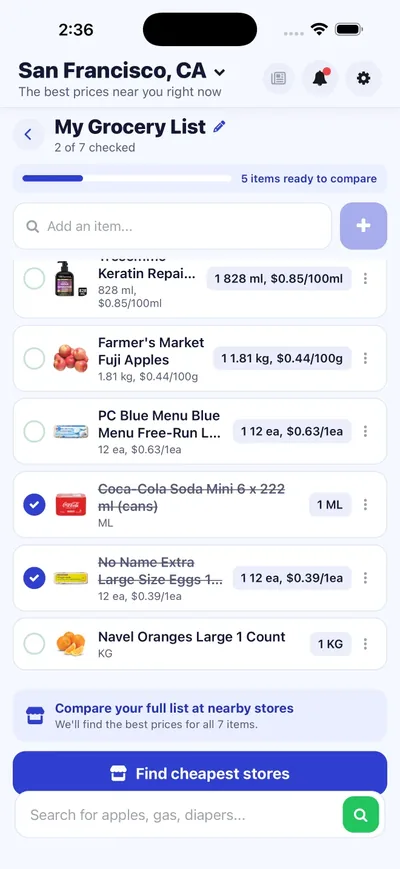
The store with the best deal on one item isn't always the cheapest place for your whole shop. Spargo's list optimizer totals your list at nearby stores and shows you where to buy it for less.
One great deal doesn't make a cheap shop.
Flyers are designed to get you through the door with a few standout prices. Once you're there, the rest of your list is priced however that store prices it, and that can wipe out the saving.
Comparing a whole list by hand means checking every item at every store and adding it all up. The list optimizer does that work for you, for every store near you, in one go.
From list to cheapest store.
Add your items
Search for what you need and add it to your list.
Spargo prices each item nearby
It checks the latest confirmed price for every item at the stores within reach of you.
See your options
You get the cheapest single store for the whole list, plus the best split between two stores if a second stop saves you more.
Choose and go
Pick the option that suits your day, then get directions and store hours.
What the optimizer looks at.
A six-item list priced at three nearby stores. Prices here are made up to show the method.
| Item | Store A | Store B | Store C |
|---|---|---|---|
| Milk, 4 L | $6.49 | $5.99 | $6.79 |
| Sliced bread, 675 g | $3.49 | $3.79 | $2.99 |
| Large eggs, dozen | $4.79 | $4.29 | $4.99 |
| Bananas, 1 kg | $1.74 | $1.52 | $1.65 |
| Chicken breast, 1 kg | $14.99 | $16.49 | $13.49 |
| White rice, 2 kg | $6.99 | $5.49 | $7.49 |
| List total | $38.49 | $37.57 | $37.40 |
Cheapest single store: Store C, at $37.40. It isn't the cheapest for every item, but it wins on the total.
Best two-store split: Store B and Store C, at $33.77 (milk at Store B, sliced bread at Store C, large eggs at Store B, bananas at Store B, chicken breast at Store C, white rice at Store B). That's $3.63 less than the best single store.
Whether $3.63 is worth a second stop depends on the drive. That's why Spargo shows both options with their distances instead of always pushing the split.
Build a list that saves more.
Be flexible on brand where it doesn't matter
Store brands are often cheaper for staples like rice, flour, canned goods and cleaning supplies. Saving brand loyalty for the few items you really care about widens your options.
Compare by unit price
A bigger pack is usually, but not always, cheaper per kilogram. Spargo shows unit prices so you can tell at a glance.
Stock up when staples are low
For things that keep, like pasta, canned goods and toiletries, buying extra when the price is good beats paying full price every week.
Plan the second stop around your week
A two-store split pays off most when the second store is on a route you already drive.
Common questions.
Can the optimizer split my list across more than two stores?
The optimizer focuses on the cheapest single store and the best two-store split. Most shoppers don't want more than two stops for one shop.
Does it use sale prices?
It uses the latest confirmed price for each item at each store, which includes current deals when we have them. Each price shows when it was last confirmed.
Is the example on this page real?
No. The store names and prices in the example are made up to show how the optimizer works. They are not real Calgary prices.
When can I use it?
The list optimizer is part of Spargo at launch, starting in Calgary. Join the waitlist to get early access.
Try the list optimizer first.
Join the waitlist and price your first list as soon as Spargo opens in Calgary.
By joining, you agree to receive launch updates from Spargo. No spam. Unsubscribe anytime. Privacy policy